How to play
This is not a simulation racer and not a top-down dodger. What you see is a road that keeps folding into the horizon: wide near your bumper, narrow far away, guardrails shrinking with it and lamp posts growing out of the dark one by one. The car stays pinned near the bottom of the screen; the road is what moves. Speed therefore is not read off a dial — you read it from how fast the rumble strips slide backwards and how quickly the lamps come at you.
Each road has its own temper. City stacks short corners between elevated sections and billboards. Coast has the biggest climbs, and a crest hides the next hundred metres. Ridge runs long, tight corners with the guardrail right against your door. Every road uses the same corner sequence every time, so the first run is unfamiliar and the fifth is a set of places where you know to lift.
- Roads
- 3 (City / Coast / Ridge)
- Distance
- 30 km each
- Checkpoints
- 4 per road, fixed positions
- Clock
- 36 seconds, +20 per checkpoint
- Traffic
- 18 cars
- Nitro
- 3 charges, refilled at checkpoints
- Speed
- 240 normal / 320 on nitro
- Records
- Fastest time per road, on this device


Controls
Three roads, one run each

One road, one run. The finish sits at the end of 30 km, and the four checkpoints land at 16%, 36%, 58% and 80% of the route. Those positions are fixed rather than randomised, so on your second run you already know whether a checkpoint hides behind the next corner.
City packs the tightest corner spacing, which makes it the place to learn steering and centrifugal pull. Coast stretches the climbs, and a crest can hide the road ahead for a hundred metres, so traffic tends to appear out of nowhere. Ridge has the sharpest corners and the narrowest shoulders, and every brush against the rail costs you another acceleration. Each road keeps its own fastest time, and one never overwrites another.
Routes are chosen on the title screen: the three buttons are the three roads. After a run you can repeat the same road straight from the results, or go back and pick another.
- City: rapid short corners and the densest neon — the place to learn the feel;
- Coast: the most elevation, with crests cutting off the view ahead;
- Ridge: long corners and narrow shoulders, where 18 cars feel closest;
- Every road reuses its own corner sequence, so the layout can be learned.
Corners push you outward
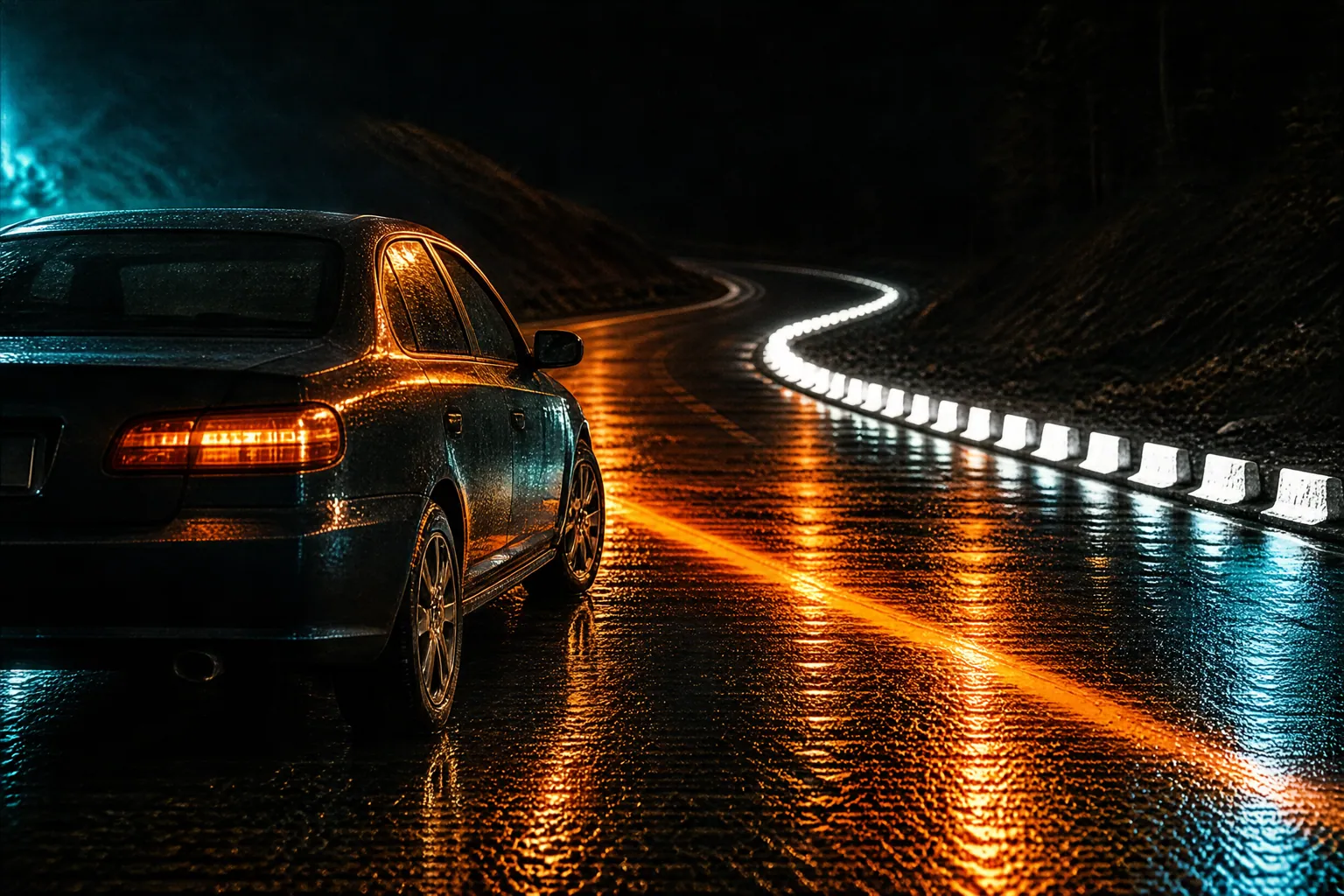
The hard part of a corner is not turning. It is that turning early and turning late both cost speed. The road bends to one side, and the car is walked toward the outside of the bend a little more the faster you go. If you do not place the car on the inside before turn-in, you will be collecting it from the shoulder on the way out.
Running onto the shoulder does not end the run, but it drops you to around 95 km/h, shakes the frame and forces a fresh acceleration once you are back on tarmac. Losing that on one long corner usually costs more than a single crash. A crash is blunter still: speed falls to 45% of what it was, the nitro in hand is cancelled, the view jolts and a dull horn thumps. Contacts never take a checkpoint away and never end the run — they just hand time back.
One trick that works: lift before turn-in, let the car slide to the inside, and get back on the throttle after the apex. It sounds slower and is measurably quicker, because sawing at the wheel mid-corner keeps the front wheels pointed away from the exit.
Thirty-six seconds and four top-ups

You leave the line with 36 seconds. Four checkpoints add 20 each, so a run can hand you at most 116 seconds. The full 30 km takes about 81 seconds at a steady 240 km/h, which means the clock is not loose change: two shoulder excursions and one crash and what is left is only enough to finish carefully, not to play with.
Nitro comes as three charges. Each one lifts you from 240 to 320 km/h for roughly a second and a half. It does not trickle back on its own; only a checkpoint refills all three at once. Over a clean run that is three charges plus one refill per checkpoint — seven bursts at most.
Where you spend them matters more than how many you have. The end of a straight is worth it, because a second and a half carries you all the way to the next corner. Mid-corner it simply fires you into the rail, and at that speed the outward pull is worse. After the third checkpoint the road usually opens up; saving the last charges for that stretch is how a personal best usually falls.
- Start with 36 seconds; four checkpoints add 20 each, 116 in total;
- Three charges, 1.5 seconds each, 240 to 320 km/h;
- Charges only refill at checkpoints and never regenerate on their own;
- A flat-out run takes about 81 seconds, so the margin is built by not crashing.
Eighteen cars and three rules

Eighteen cars are always out there with you. They come in a handful of colours and cruising speeds; the slow ones sit toward the outside, the quick ones change lane by themselves. None of them veers out of a side road and none comes at you head-on. They all run the same direction and all run slower, which makes this a chase rather than a slalom.
First rule: they do not yield. Touch one and you take the 45% speed cut. Second: a car you just hit goes briefly cold, so you will not be judged twice by the same bumper — do not sit there grinding against it. Third: their speeds are fixed, so the same stretch holds the same queue every time you drive it, and you can learn where it clumps.
Traffic does not clear when you take a checkpoint. The queue is exactly where it was, which is why charging out of a fresh 20 seconds straight into a pack is such a common way to waste it.
Arriving, or being collected

A run ends in one of two ways. Cover the 30 km and you arrive: the results list your time, contacts, checkpoints cleared and the fastest time for that road on this device. Let the clock reach zero and the run is collected: you get where you got to and how many checkpoints you cleared.
The record is a time, lower is better, kept separately for each of the three roads. Crashes, shoulder excursions and a badly timed charge all end up in that single number, which makes chasing a personal best unusually legible: one fewer contact, one less slide, and the number drops.
Records live in this browser only. Another device, another browser, or clearing site data starts from zero. No account, no cloud — the same as the other small games here.
Questions
- How do I use nitro on a phone?
- Hold the left or right half of the canvas to steer; throttle is automatic. The round button at the lower right burns one charge, and you can tap it while steering.
- Why does every corner throw me wide?
- The car is walked toward the outside of a bend, more so at speed. Put it on the inside before turn-in and get back on the power after the apex; it works better than sawing at the wheel mid-corner.
- I keep running out of time. What should I change?
- Time only comes from the four checkpoints, at 16%, 36%, 58% and 80% of the route. Learn roughly where those land, then decide which stretch deserves a charge.
- Does a crash end the run?
- No. It cuts speed to 45% and cancels the charge in hand. Contacts are counted in the results, but they never remove a checkpoint and never end the run.
- Do my records sync to another device?
- No. There is no account and no server; the fastest time lives only in this browser’s local storage.